Power Station vs Generator for Home Backup: How to Choose
Quick Answer
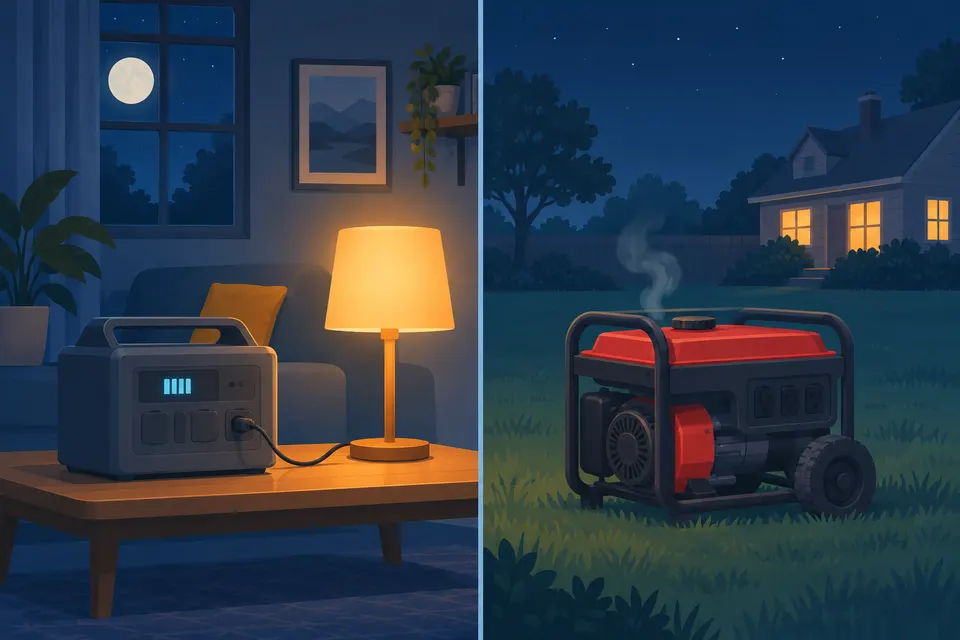
Choose a power station if your outages are short to moderate, you want to run loads indoors or overnight without exhaust, and you can recharge from the grid or solar. Choose a generator if you need to keep going for days with no recharge source. If both describe you, a hybrid plan covers more outages than either tool alone.
On this page
- What is the core difference: energy or fuel?
- How do output and surge compare?
- Where can you run each one?
- What about noise, maintenance and fuel storage?
- How do you connect either one to the house?
- Which should you choose? A decision flow
- Why do many households use both?
- Frequently Asked Questions
- Our Take
- Sources
Key Takeaways
- A power station is a bucket of energy (watt-hours). A generator is a tap that runs as long as it has fuel.
- Portable gas generators must run outdoors, more than 20 feet from windows, doors and vents (CDC, 2026). Power stations have no combustion exhaust.
- Both need a licensed electrician if you want them tied into house wiring through a transfer switch or interlock.
- For long outages, many households pair the two: battery for quiet overnight loads, generator for the days it cannot cover.
Models compared by spec
- Capacity
- 1,024 Wh
- Continuous output
- 1,800 W
- Battery type
- LiFePO4
- Expandable
- To 5,000 Wh
- 240V
- No
- Weight
- 27.6 lb
- Capacity
- 2,048 Wh
- Continuous output
- 2,400 W
- Battery type
- LiFePO4
- Expandable
- To 4,096 Wh
- 240V
- No
- Weight
- 41.7 lb
- Capacity
- 2,048 Wh
- Continuous output
- 2,400 W
- Battery type
- LiFePO4
- Expandable
- Yes
- 240V
- No
- Weight
- 45 lb
- Capacity
- 2,073.6 Wh
- Continuous output
- 2,600 W
- Battery type
- LiFePO4
- Expandable
- No
- 240V
- No
- Weight
- 53.35 lb
- Capacity
- 2,764.8 Wh
- Continuous output
- 3,840 W
- Battery type
- LiFePO4
- Expandable
- To 19,354 Wh
- 240V
- Yes
- Weight
- 83.78 lb
- Capacity
- 3,072 Wh
- Continuous output
- 3,600 W
- Battery type
- LiFePO4
- Expandable
- To 12,288 Wh
- 240V
- Linked
- Weight
- 91.5 lb
- Capacity
- 3,072 Wh
- Continuous output
- 3,600 W
- Battery type
- LiFePO4
- Expandable
- No
- 240V
- No
- Weight
- 59.52 lb
- Capacity
- 3,072 Wh
- Continuous output
- 3,600 W
- Battery type
- LiFePO4
- Expandable
- To 15,360 Wh
- 240V
- No
- Weight
- 83.3 lb
- Capacity
- 3,072 Wh
- Continuous output
- 3,600 W
- Battery type
- LiFePO4
- Expandable
- Yes
- 240V
- Linked
- Weight
- 79 lb
- Capacity
- 3,072 Wh
- Continuous output
- 3,600 W
- Battery type
- LiFePO4
- Expandable
- Yes
- 240V
- No
- Weight
- 63.3 lb
- Capacity
- 3,600 Wh
- Continuous output
- 3,600 W
- Battery type
- LiFePO4
- Expandable
- To 10,800 Wh
- 240V
- Linked
- Weight
- 99 lb
- Capacity
- 3,840 Wh
- Continuous output
- 6,000 W
- Battery type
- LiFePO4
- Expandable
- To 26,880 Wh
- 240V
- Yes
- Weight
- 136.7 lb
- Capacity
- 3,993.6 Wh
- Continuous output
- 3,600 W
- Battery type
- LiFePO4
- Expandable
- To 20,000 Wh
- 240V
- Linked
- Weight
- 115.74 lb
- Capacity
- 4,096 Wh
- Continuous output
- 4,000 W
- Battery type
- LiFePO4
- Expandable
- Yes
- 240V
- Yes
- Weight
- 113.54 lb
- Capacity
- 5,040 Wh
- Continuous output
- 7,200 W
- Battery type
- LiFePO4
- Expandable
- Yes
- 240V
- Yes
- Weight
- 134.5 lb
- Capacity
- 5,120 Wh
- Continuous output
- 7,200 W
- Battery type
- LiFePO4
- Expandable
- To 35,800 Wh
- 240V
- Yes
- Weight
- 123.9 lb
- Capacity
- 6,144 Wh
- Continuous output
- 7,200 W
- Battery type
- LiFePO4
- Expandable
- To 30,720 Wh
- 240V
- Yes
- Weight
- —
Specs from manufacturer pages, checked Nov 2026. Each model page links the source of every value. “Linked” 240V means 240V only by pairing two units or with the brand’s hub, not from one unit alone.
No model in our list matches every filter. Clear a filter, or see how expansion batteries and two linked units change the picture on each model page.
What is the core difference: energy or fuel?
A power station holds a set amount of energy, listed in watt-hours (Wh) on the spec sheet. When it is empty, it is done until you recharge it from the grid, solar, or another source. A generator has no such ceiling, because it turns fuel into electricity and keeps going until the fuel runs out.
So the question is not "which is stronger" but "which limit hurts you more". A battery limit is easy to plan for: divide watt-hours by the average watts you draw. A fuel limit depends on how much fuel you have stored and can safely refuel.
Here is how the planning arithmetic works for a refrigerator. The Virginia Cooperative Extension guidance, based on DOE figures, says a refrigerator runs about one third of the time it is plugged in, and that motor start-up draws roughly three times the running current [5]. The sizing calculator on this site uses a 225 W running figure, which averages out to roughly 74 W over time. Our planning assumption (not a government number) is that the inverter loses about 15% of stored energy, so only about 85% of the rated watt-hours reaches your devices. For your own numbers, try the home backup sizing tool and the runtime calculator.
How do output and surge compare?
Two numbers matter for any appliance: running watts and surge watts. Motors in refrigerators, sump pumps and furnace blowers draw a short burst on start-up, roughly three times running power by the Extension rule above, and the equipment you buy has to cover that burst as well as the steady load.
Power station spec sheets list continuous output and, for many models, a surge figure. Here are a few from our spec database, shown only as examples of the range, not as a ranking.
| Model | Capacity (Wh) | Continuous output (W) | Surge (W) | 240V |
|---|---|---|---|---|
| BLUETTI Apex 300 | 2,764.8 | 3,840 | not confirmed | Native |
| EcoFlow DELTA Pro 3 | 4,096 | 4,000 | 8,000 | Native |
| Anker SOLIX F3800 Plus | 3,840 | 6,000 | not confirmed | Native |
| Jackery Explorer 5000 Plus | 5,040 | 7,200 | not confirmed | Native |
Figures are manufacturer-listed values; "not confirmed" means no surge rating has been verified for that model. The full list sits in the home backup power station comparison, and you can browse manufacturers such as BLUETTI, EcoFlow, Anker SOLIX and Jackery.
Generator ratings come from the maker's label and manual, and the same logic applies: add up running watts, then check the start-up burst of your largest motor. Read the rated output on the nameplate rather than trusting a headline number.
Where can you run each one?
This is the biggest practical gap. A portable gas generator burns fuel and exhausts carbon monoxide (CO), a gas you cannot see or smell. CDC guidance says to operate a generator outdoors, more than 20 feet from windows, doors and vents, and never to run one inside the home or garage, even with doors and windows open [1]. Ready.gov gives similar direction: use it only outdoors, at least 20 feet away from windows, doors and attached garages [4].
The CPSC adds that deadly CO levels can build up quickly in enclosed areas such as crawlspaces and sheds, and can linger for hours even after the generator has shut off [2]. CDC also advises a battery-powered or battery backup CO detector in the home while a generator runs [1].
A power station has no combustion engine and no exhaust, so this particular hazard does not apply to it. You still follow the manufacturer's manual for ventilation, heat and placement. Because it does not burn fuel, a battery unit can sit in a room beside the loads it feeds, which is why it suits overnight and bad-weather use.
What about noise, maintenance and fuel storage?
OSHA lists noise and vibration among the hazards of portable generators and advises keeping them as far as possible from work areas and gathering spaces [3]. We do not quote decibel figures here, because manufacturers measure them differently and we have no neutral source for them. Check each model's spec sheet.
Fuel is the other practical burden. The CPSC says never to store generator fuel in the home; gasoline, propane, kerosene and similar liquids belong outside living areas in properly labeled, non-glass safety containers, away from fuel-burning appliances such as a gas water heater in a garage [2]. Before refueling, shut the generator down and let it cool, because fuel spilled on hot engine parts can ignite [3]. OSHA adds that overloading a generator can cause overheating and a fire hazard.
A power station has no fuel to store or pour. Its upkeep is about keeping the battery charged and following the manufacturer's storage guidance, so read the manual. For either tool, run it periodically as the manufacturer instructs rather than finding out in the first hour of an outage that something has failed.
How do you connect either one to the house?
Plugging appliances directly into the unit with properly rated cords is the simple route for both. Powering circuits in the house is a different matter and a job for a licensed electrician. OSHA says to never attach a generator directly to a building's electrical system unless a qualified electrician has properly installed it with a transfer switch, because the wrong connection can energize wiring for a great distance and endanger utility workers [3]. The CPSC warns about the same danger from plugging a generator into a wall outlet [2].
That is why the 240V column in the table matters: whole-home circuits like a furnace or well pump may need a transfer switch or interlock, and the installer will tell you what your panel allows. We do not give wiring instructions here. Tell the electrician which unit you plan to use, and ask the manufacturer which connection hardware it supports.
Which should you choose? A decision flow
Why do many households use both?
Because the limits do not overlap. A battery handles the quiet hours: the refrigerator, a router, lights and phone charging overnight, with no exhaust and no refueling in the dark. A generator, run outdoors in daylight, covers heavier or longer needs. Ready.gov itself advises to plan for batteries and other alternative power sources [4].
Some power stations accept AC or solar input. Whether a given unit can be charged from a generator is a question for its manual, so confirm it before you plan around it. To estimate how fast solar could refill a unit between cloudy days, use the solar recharge time tool.
| Power station | Portable gas generator | |
|---|---|---|
| What limits run time | Stored watt-hours | Fuel on hand |
| Recharge or refuel | Wall outlet, solar, or other inputs the maker lists | Add fuel (store it outside living areas) |
| Indoor use | No combustion exhaust; follow the manual | Never indoors; outdoors, more than 20 ft from openings |
| Noise | Check each spec sheet | OSHA lists noise and vibration as hazards |
| Fuel storage | None | Approved containers, outside the home (CPSC) |
| Connecting to the house | Licensed electrician, transfer switch or interlock | Qualified electrician and transfer switch (OSHA) |
| Good fit | Short outages, overnight loads, apartments | Long outages with fuel and outdoor space |
Frequently Asked Questions
Can I run a portable generator in my garage with the door open?
No. CDC and CPSC both say never to run a generator inside a home or garage, even with doors and windows open. Run it outdoors, more than 20 feet from windows, doors and vents [1].
Is a power station safe to use indoors?
It has no combustion exhaust, so the carbon monoxide rules for gas generators do not apply to it. Still follow the manufacturer's manual on ventilation, heat and placement.
Can I plug a generator or power station into a wall outlet to power the house?
No. The CPSC calls this backfeeding and warns of electrocution risk to utility workers and neighbors [2]. Whole-house connections need a transfer switch installed by a qualified electrician [3].
How do I know if a power station is big enough?
Add the running watts of what you want to power, check the largest start-up surge, and divide usable watt-hours by average watts. The home backup sizing tool does this for you.
Our Take
We think the choice is less about technology and more about your outage pattern and your home. If your outages run a day or less, and you want quiet, indoor-friendly power with no fuel to store, a power station fits well. If you face multi-day events and have outdoor space and a safe place to store fuel, a generator is a reasonable part of the plan. The hybrid approach is a practical middle path, as long as every connection to house wiring goes through a licensed electrician. When you are ready to compare specific models, start with the home backup power station comparison.
Sources
- Carbon Monoxide (CO) Poisoning Basics. Centers for Disease Control and Prevention, 2026.
- CPSC Safety Alert: Portable Generator Hazards. U.S. Consumer Product Safety Commission, 2021.
- Using Portable Generators Safely. Occupational Safety and Health Administration, 2005.
- Power Outages. Ready.gov, 2026.
- Estimating Appliance and Home Electronic Energy Use (2901-9014). Virginia Cooperative Extension, 2026.
General information, not electrical, medical or safety advice. Wattages are typical figures; check the label on your own appliance. Connecting backup power to home wiring needs a transfer switch or interlock installed by a licensed electrician. Spotted an error? Tell us.
More Home Backup Guides
Backup Power for Medical Devices: How to Check the Power Draw
How to find the watts on your home medical equipment label, turn them into watt-hours for an outage, and what to ask your provider and utility first.
Backup Battery for Sump Pump: Dedicated System or Power Station?
Compare a dedicated battery backup sump pump with running your existing pump from a home power station, with the watts, surge and Wh math shown.
Portable Power Station for a Gas Furnace: What Size Do You Need?
A gas furnace still needs electricity for its blower and controls. See how many watt-hours 12, 24 and 48 hours take, and what the hookup requires.
Battery Backup for a Refrigerator: How Big a Power Station You Need
How much battery backup a refrigerator needs: running vs start-up watts, daily Wh, 12, 24 and 48 hour sizing, food-safety timing, and models that fit.