Portable Power Station for a Gas Furnace: What Size Do You Need?
Quick Answer
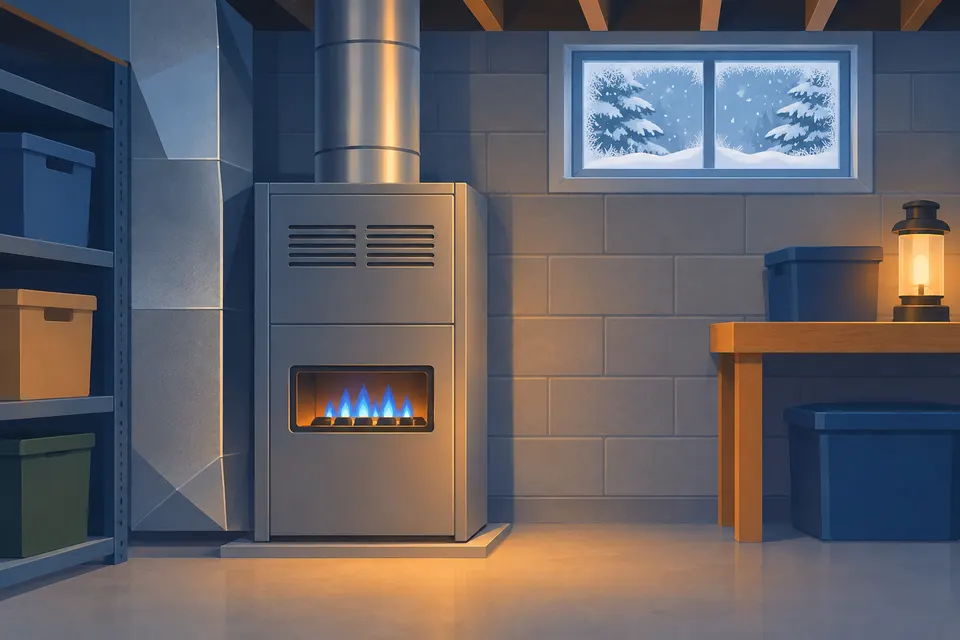
Yes, a battery can run a gas furnace, because the furnace only needs electricity for its fan, igniter and controls. Size it from the nameplate watts, a realistic run time and our 85% planning assumption. The connection to the furnace is the harder part: it must be done by a licensed electrician. Use the calculator above to try your own numbers. The rest of this page explains where the figures come from.
On this page
- Why a gas furnace still needs electricity
- Why a battery works for gas heat but not for electric heat
- Start-up surge of the blower motor
- How many watt-hours for 12, 24 and 48 hours
- Which power stations fit by spec
- The hookup: why most furnaces need an electrician
- Carbon monoxide and the furnace itself
- Frequently Asked Questions
- Our Take
- Sources
Key Takeaways
- A gas furnace burns gas for heat, but its blower, igniter and control board run on electricity, so a power outage can mean no heat.
- The electric load is small compared with electric heat. Planning figures run from about 180 W to 750 W while the furnace is running, so check your furnace nameplate.
- With our 85% planning assumption and a furnace that runs half the time, 24 hours takes roughly 4,200 Wh at a 295 W blower. A 750 W blower takes about 10,600 Wh.
- Most furnaces are hardwired. Powering one from a power station needs a transfer switch or inlet installed by a licensed electrician, following the furnace maker's instructions.
Models compared by spec
- Capacity
- 1,024 Wh
- Continuous output
- 1,800 W
- Battery type
- LiFePO4
- Expandable
- To 5,000 Wh
- 240V
- No
- Weight
- 27.6 lb
- Capacity
- 2,048 Wh
- Continuous output
- 2,400 W
- Battery type
- LiFePO4
- Expandable
- To 4,096 Wh
- 240V
- No
- Weight
- 41.7 lb
- Capacity
- 2,048 Wh
- Continuous output
- 2,400 W
- Battery type
- LiFePO4
- Expandable
- Yes
- 240V
- No
- Weight
- 45 lb
- Capacity
- 2,073.6 Wh
- Continuous output
- 2,600 W
- Battery type
- LiFePO4
- Expandable
- No
- 240V
- No
- Weight
- 53.35 lb
- Capacity
- 2,764.8 Wh
- Continuous output
- 3,840 W
- Battery type
- LiFePO4
- Expandable
- To 19,354 Wh
- 240V
- Yes
- Weight
- 83.78 lb
- Capacity
- 3,072 Wh
- Continuous output
- 3,600 W
- Battery type
- LiFePO4
- Expandable
- To 12,288 Wh
- 240V
- Linked
- Weight
- 91.5 lb
- Capacity
- 3,072 Wh
- Continuous output
- 3,600 W
- Battery type
- LiFePO4
- Expandable
- No
- 240V
- No
- Weight
- 59.52 lb
- Capacity
- 3,072 Wh
- Continuous output
- 3,600 W
- Battery type
- LiFePO4
- Expandable
- To 15,360 Wh
- 240V
- No
- Weight
- 83.3 lb
- Capacity
- 3,072 Wh
- Continuous output
- 3,600 W
- Battery type
- LiFePO4
- Expandable
- Yes
- 240V
- Linked
- Weight
- 79 lb
- Capacity
- 3,072 Wh
- Continuous output
- 3,600 W
- Battery type
- LiFePO4
- Expandable
- Yes
- 240V
- No
- Weight
- 63.3 lb
- Capacity
- 3,600 Wh
- Continuous output
- 3,600 W
- Battery type
- LiFePO4
- Expandable
- To 10,800 Wh
- 240V
- Linked
- Weight
- 99 lb
- Capacity
- 3,840 Wh
- Continuous output
- 6,000 W
- Battery type
- LiFePO4
- Expandable
- To 26,880 Wh
- 240V
- Yes
- Weight
- 136.7 lb
- Capacity
- 3,993.6 Wh
- Continuous output
- 3,600 W
- Battery type
- LiFePO4
- Expandable
- To 20,000 Wh
- 240V
- Linked
- Weight
- 115.74 lb
- Capacity
- 4,096 Wh
- Continuous output
- 4,000 W
- Battery type
- LiFePO4
- Expandable
- Yes
- 240V
- Yes
- Weight
- 113.54 lb
- Capacity
- 5,040 Wh
- Continuous output
- 7,200 W
- Battery type
- LiFePO4
- Expandable
- Yes
- 240V
- Yes
- Weight
- 134.5 lb
- Capacity
- 5,120 Wh
- Continuous output
- 7,200 W
- Battery type
- LiFePO4
- Expandable
- To 35,800 Wh
- 240V
- Yes
- Weight
- 123.9 lb
- Capacity
- 6,144 Wh
- Continuous output
- 7,200 W
- Battery type
- LiFePO4
- Expandable
- To 30,720 Wh
- 240V
- Yes
- Weight
- —
Specs from manufacturer pages, checked Nov 2026. Each model page links the source of every value. “Linked” 240V means 240V only by pairing two units or with the brand’s hub, not from one unit alone.
No model in our list matches every filter. Clear a filter, or see how expansion batteries and two linked units change the picture on each model page.
Why a gas furnace still needs electricity
Gas supplies the heat, but the furnace cannot move that heat without power. A U.S. Department of Energy project summary on furnaces states the consequence plainly: for a gas furnace, "power outage = no heat" [1]. The same document breaks down one example furnace at 180 W average electric load while running, with the supply air blower at 140 W and the igniter at about 10 W on average.
Why a battery works for gas heat but not for electric heat
A gas furnace asks for a few hundred watts, and only while it is heating. Resistance electric heat turns electricity directly into heat, so it asks for far more. For scale, the appliance table from Virginia Cooperative Extension, built on U.S. DOE figures, lists a space heater at up to 1,500 W [3], several times a typical gas furnace blower.
Your furnace is not one of these examples. Read the nameplate or the manual for its rated amps and volts, and multiply them to get watts. The calculator above uses 295 W as its furnace preset, taken from the U.S. DOE Energy Saver appliance calculator [2], and assumes the blower runs half the time while heating. That duty cycle is our assumption, not a measured figure. A cold night with a long run time pushes it higher.
Start-up surge of the blower motor
Motors draw more current when they start. The Virginia Cooperative Extension table notes the meter shows about three times more current while a motor is starting than when it runs smoothly [3]. We use 3 times running watts as the planning surge. That is 885 W for a 295 W blower and 2,250 W for a 750 W blower. Compare it with the continuous watts a power station lists, and with its surge rating where the manufacturer gives one.
How many watt-hours for 12, 24 and 48 hours
The math is average watts, divided by 0.85, times hours. The 85% is our planning assumption for inverter losses. It is not a government figure, so treat the results as a starting point.
| Blower running watts | Average (50% duty) | Battery draw (÷ 0.85) | 12 hours | 24 hours | 48 hours | Planning surge (3×) |
|---|---|---|---|---|---|---|
| 180 W (DOE example) | 90 W | 106 W | 1,271 Wh | 2,541 Wh | 5,082 Wh | 540 W |
| 295 W (DOE calculator) | 147.5 W | 173.5 W | 2,082 Wh | 4,164 Wh | 8,329 Wh | 885 W |
| 750 W (VT table) | 375 W | 441 W | 5,294 Wh | 10,588 Wh | 21,176 Wh | 2,250 W |
If your furnace has other electric parts, such as a draft inducer, add their watts from the nameplate. The DOE example above lists a 25 W combustion blower in addition to the supply air blower.
Which power stations fit by spec
All figures below come from each manufacturer's published specs as recorded on our model pages. They cover the 295 W case (2,082 Wh for 12 hours, 4,164 Wh for 24 hours). Rated capacity is nameplate watt-hours, so a battery sized exactly to the need leaves no margin. Maximum expanded capacity is the manufacturer's own figure and requires its extra batteries.
| Model | Rated capacity | Continuous output | 12 h (2,082 Wh) | 24 h (4,164 Wh) | Max expanded (maker's figure) |
|---|---|---|---|---|---|
| BLUETTI Apex 300 | 2,764.8 Wh | 3,840 W | Single unit | With expansion | 19,353.6 Wh |
| EcoFlow DELTA Pro 3 | 4,096 Wh | 4,000 W | Single unit | Just short alone | Not confirmed |
| EcoFlow DELTA Pro Ultra | 6,144 Wh | 7,200 W | Single unit | Single unit | 30,720 Wh |
| Goal Zero Yeti PRO 4000 | 3,993.6 Wh | 3,600 W | Single unit | Just short alone | 20,000 Wh |
| Anker SOLIX F3800 Plus | 3,840 Wh | 6,000 W | Single unit | Just short alone | 26,880 Wh |
| Pecron F5000LFP | 5,120 Wh | 7,200 W | Single unit | Single unit | 35,800 Wh |
| Jackery Explorer 5000 Plus | 5,040 Wh | 7,200 W | Single unit | Single unit | Not confirmed |
| OUPES Mega 3 | 3,072 Wh | 3,600 W | Single unit | With expansion | 15,360 Wh |
| Jackery HomePower 3000 | 3,072 Wh | 3,600 W | Single unit | Not alone | Not expandable |
The 48-hour case at 295 W (8,329 Wh) is beyond any single unit listed here, so it points to expandable systems, a lower duty cycle, or extra charging. A solar array can top up between cycles; see the solar recharge time tool. For brand-level specs, see BLUETTI, EcoFlow, Goal Zero, Anker SOLIX, Pecron, OUPES and Jackery.
For a full side-by-side of home backup models, open the home backup power station comparison. To size a whole-home load rather than only a furnace, use the home backup sizing tool, and use the runtime calculator to turn a specific model's capacity into hours.
The hookup: why most furnaces need an electrician
Most furnaces are wired into the house circuit, not plugged into a wall outlet. You cannot simply plug a hardwired furnace into a power station. Connecting a power station to a furnace or to household wiring is work for a licensed electrician, using a transfer switch or an inlet that is installed to the code in your area and that follows the furnace maker's instructions.
OSHA's fact sheet on portable generators gives the principle: never attach a generator directly to a building's electrical system unless a qualified electrician has properly installed it with a transfer switch [4]. Doing otherwise can energize wiring over a wide area and put utility workers at risk. The warning is written for generators, and the wiring risk applies to any backup power source you connect to a home. Ask your electrician what your furnace and local code allow before you buy anything.
Carbon monoxide and the furnace itself
A battery makes no exhaust, but your furnace still burns gas and vents it. Keep working carbon monoxide alarms on every level of the home. The U.S. Consumer Product Safety Commission says CO alarms should be installed on each level of the home and outside sleeping areas, with batteries replaced annually and alarms tested monthly [5]. Ready.gov advises carbon monoxide detectors with battery backup on every level of the home [6]. It also says never to use a gas stove or oven to heat your home.
Frequently Asked Questions
Can a portable power station run a furnace?
By watts, yes, for a gas furnace. The blower and controls draw a few hundred watts in the planning figures above. The practical question is the connection, which needs a licensed electrician.
Does a gas furnace work without electricity?
No. The DOE summary quoted above states "power outage = no heat" for a gas furnace, because the blower, igniter and controls need power.
How big a battery do I need for battery backup for a furnace?
Start with the nameplate watts, assume the furnace runs about half the time, and divide by 0.85. A 295 W blower works out to about 2,082 Wh for 12 hours and 4,164 Wh for 24 hours. Use the calculator above for your own numbers.
Can a power station run an electric furnace or electric heat?
Electric resistance heat draws much more than a gas furnace blower. A 1,500 W space heater at 50% duty needs about 21,176 Wh for 24 hours under the same math. Check the nameplate of any electric heat before sizing.
Our Take
We think the furnace load is one of the easier backup jobs to size, and the hookup is the part that deserves the attention. Pick the capacity from your nameplate watts and the hours you want to cover, leave margin for cold nights when the blower runs longer, and have an electrician plan the connection before you buy anything. If the goal is hours rather than days, a single large unit by spec may be enough. For longer outages, plan for expansion or recharging, and check the furnace maker's manual first.
Sources
- Drop-in Retrofit Furnace for Maximum Efficiency: Self-Powered System. U.S. Department of Energy, Critical Materials and Energy Innovation, 2026.
- Energy Saver Appliance and Electronic Energy Use Calculator. U.S. Department of Energy, 2026.
- Estimating Appliance and Home Electronic Energy Use (2901-9014). Virginia Cooperative Extension, 2026.
- Using Portable Generators Safely. OSHA, 2026.
- CO Alarms. U.S. Consumer Product Safety Commission, 2026.
- Power Outages. Ready.gov, 2026.
General information, not electrical, medical or safety advice. Wattages are typical figures; check the label on your own appliance. Connecting backup power to home wiring needs a transfer switch or interlock installed by a licensed electrician. Spotted an error? Tell us.
More Home Backup Guides
Power Station vs Generator for Home Backup: How to Choose
Portable power station vs generator for home backup: energy versus fuel, surge, indoor use, carbon monoxide rules, upkeep and wiring, plus a decision flow.
Backup Power for Medical Devices: How to Check the Power Draw
How to find the watts on your home medical equipment label, turn them into watt-hours for an outage, and what to ask your provider and utility first.
Backup Battery for Sump Pump: Dedicated System or Power Station?
Compare a dedicated battery backup sump pump with running your existing pump from a home power station, with the watts, surge and Wh math shown.
Battery Backup for a Refrigerator: How Big a Power Station You Need
How much battery backup a refrigerator needs: running vs start-up watts, daily Wh, 12, 24 and 48 hour sizing, food-safety timing, and models that fit.