Backup Power for Medical Devices: How to Check the Power Draw
Quick Answer
Find the watts on your device's label or in its manual. If only amps and volts are printed, multiply them. Multiply watts by the hours you need, then divide by 0.85 for our planning assumption. Before relying on any backup source, ask your equipment provider or doctor, and contact your utility.
On this page
Key Takeaways
- This page is only about reading the power draw of your equipment. It does not say any power station is safe or suitable for medical use.
- Your device label or manual gives watts, or amps and volts. Multiply amps by volts if watts are not printed.
- Watts times hours gives watt-hours. Our planning assumption adds a 15% inverter loss, so divide by 0.85.
- Ask your equipment provider and doctor about your device before you rely on any backup source. Official guidance says to do this ahead of time.
What do official sources say about planning first?
Start with the people who prescribe and service the equipment. Ready.gov says to "Talk to your medical provider about a power outage plan for medical devices powered by electricity" and to "Plan for batteries and other alternative power sources to meet your needs when the power goes out" [1].
The U.S. Food and Drug Administration publishes a home-use booklet for devices that need electricity. Its checklist asks you to gather information "from the Device Manufacturer or Medical Provider," including "Does my device have a back-up system? If yes, how long will it operate and where is it located?" and "Could I be harmed if my device stops for a short period of time? If yes, what is that time period?" [2]. The booklet also lists your local power company, local fire department, family and health care providers as contacts to notify when power is lost and restored.
HHS emPOWER, the federal program built around electricity-dependent equipment, states that "Severe weather and other emergencies, especially those with prolonged power outages, can be life-threatening" [3].
If a device is life-sustaining, your provider's backup plan comes first. A power station is not a substitute for that plan, and this site cannot judge whether a given product fits your equipment.
Where do you find the watts on a medical device?
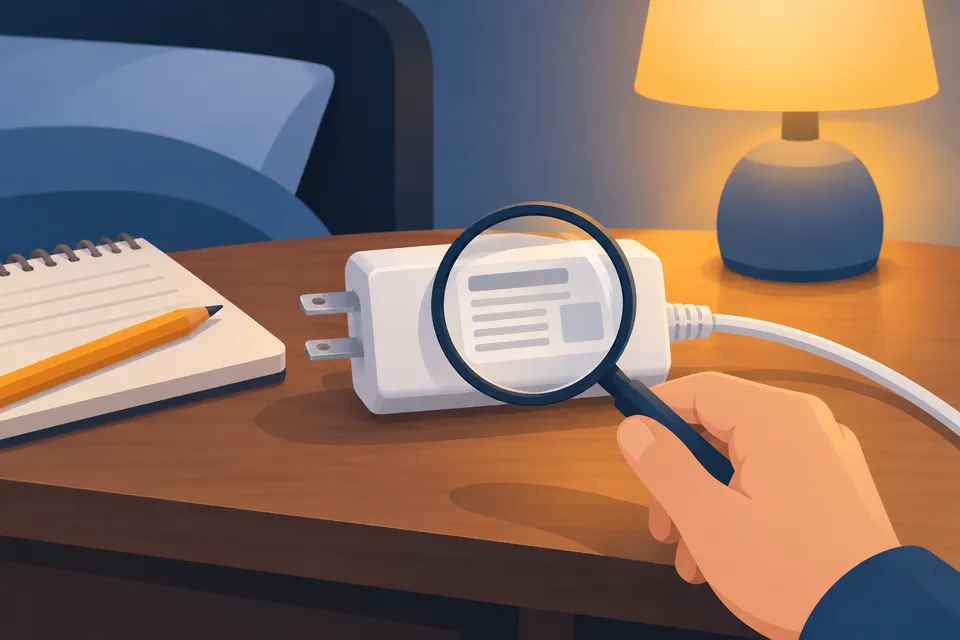
Look at the device itself, its power adapter, and the printed manual. The Virginia Cooperative Extension energy guide says to "Locate the wattage of most appliances stamped on the bottom or back of the appliance, or on its nameplate." When watts are not listed, it suggests "finding the current draw (in amperes) and multiplying that by the voltage used by the appliance," and notes that most U.S. appliances use 120 volts [4].
| What the label shows | What to do | Who to confirm with |
|---|---|---|
| Watts (W) for the device | Use that number directly | Equipment provider |
| Amps (A) and volts (V) | Multiply A x V to get W | Equipment provider |
| Separate power adapter with its own label | Read the adapter label; note whether the device runs from AC or a DC input | Device manual or manufacturer |
| Only a model number | Look up the manual from the maker, or ask the provider | Manufacturer or provider |
Two cautions apply. First, a printed rating and the draw at a given moment can differ. The same Extension guide notes that for appliances with settings, "the actual amount of power consumed depends on the setting used." Your manual or the maker should tell you whether options such as a heater or humidifier change the draw on your device. Second, if the manual lists both an AC and a DC option, ask the maker or provider which one applies to your setup. Do not guess from a forum post.
How do you turn watts into watt-hours for an outage?
Watts measure how fast a device uses energy. Watt-hours measure how much energy it uses over time. The Extension guide gives the pattern "Wattage × Hours Used per Day ÷ 1000" for kilowatt-hours, so watts times hours, without the division, gives watt-hours.
Our calculators then divide by 0.85. That is our planning assumption for inverter losses, not a figure from a government or manufacturer source. A power station's spec sheet lists its rated capacity in watt-hours, and the model pages on this site show those figures as manufacturers list them. Compare your planning number to that rating, and expect real results to differ.
The numbers below are placeholders for a worked example. They are not typical figures for any device. Replace them with the value from your own label.
| Example label value (not typical) | Hours planned | Load (W x h) | Planning Wh (÷ 0.85) |
|---|---|---|---|
| 30 W | 8 | 240 Wh | 283 Wh |
| 60 W | 8 | 480 Wh | 565 Wh |
| 90 W | 8 | 720 Wh | 848 Wh |
Amps and volts work the same way. A label reading 0.5 A at 120 V is 0.5 x 120 = 60 W, which then follows the 60 W row. For more nights, multiply the hours. The home backup sizing tool adds up several devices, and the runtime calculator turns a watt-hour rating and a load into hours.
What should you ask your provider, doctor and utility?
The FDA booklet is built around these questions. Bring them to your equipment provider or doctor, and write the answers down:
- Can a short interruption harm me, and for how long? The booklet asks: "Could I be harmed if my device stops for a short period of time? If yes, what is that time period?"
- Does my device have a built-in or optional backup, and how long does it run? The booklet asks: "How long will the device last on battery power?"
- Can my device use another power source? If so, which type does the maker support?
- What happens if power stops in the middle of a treatment?
- Which settings or accessories change how much power it draws?
Then contact your utility. FirstEnergy, one U.S. utility, tells households that depend on "electrically operated life-support equipment" to ask about its Critical Care list. The same page is blunt: "We cannot guarantee faster power restoration for customers with medical needs," and it advises customers to "have a contingency plan, such as a battery backup" [5]. Other utilities run their own programs with their own rules, so ask yours.
The FDA booklet also lists the local fire department as a contact, and Ready.gov points to a plan made with your medical provider. For a life-sustaining device, ask your provider about local emergency services and about where to go if an outage outlasts your backup.
What about generators and house wiring?
Ready.gov says "Generators and fuel should always be used outdoors and at least 20 feet away from windows, doors and attached garages" [1]. Anything that connects a backup source to your home's wiring is a job for a licensed electrician. See our home backup power station comparison for how the spec fields are laid out; it makes no medical suitability claims.
Frequently Asked Questions
How do I find the watts for my device?
Check the label on the device, the label on its adapter, and the manual. If only amps and volts are printed, multiply them. If you cannot find either, ask the manufacturer or your equipment provider.
Can I use the calculator above for a medical device?
You can enter your label watts to see a watt-hour figure. The result is arithmetic, not a medical judgment. Confirm the plan with your provider.
Does registering with my utility keep my power on?
No. FirstEnergy states it "cannot guarantee faster power restoration for customers with medical needs." Registration may help with communication, so ask your utility what it offers.
What if my device is life-sustaining?
Follow your provider's backup plan first, contact your utility, and ask local emergency services what to do if an outage runs long. Do not rely on a calculator or a spec sheet alone.
Our Take
We think the most useful thing a comparison site can do here is stay in its lane. The number on your label is simple to read and simple to convert, and that arithmetic is worth doing before an outage rather than during one. Whether any backup source fits your equipment is a question for your provider and the device maker. Treat our watt-hour figures as a way to organize that conversation, and keep the manual, provider phone number and utility contact in one place.
Sources
- Power Outages. Ready.gov, 2026.
- Home Use Devices Booklet: How to Prepare for and Handle Power Outages for Medical Devices that Require Electricity. U.S. Food and Drug Administration, 2026.
- HHS emPOWER Map. U.S. Department of Health and Human Services, 2026.
- Estimating Appliance and Home Electronic Energy Use (2901-9014). Virginia Cooperative Extension, 2026.
- Outages: Medical Support. FirstEnergy, 2026.
General information, not electrical, medical or safety advice. Wattages are typical figures; check the label on your own appliance. Connecting backup power to home wiring needs a transfer switch or interlock installed by a licensed electrician. Spotted an error? Tell us.
More Home Backup Guides

Power Station vs Generator for Home Backup: How to Choose
Portable power station vs generator for home backup: energy versus fuel, surge, indoor use, carbon monoxide rules, upkeep and wiring, plus a decision flow.
Backup Battery for Sump Pump: Dedicated System or Power Station?
Compare a dedicated battery backup sump pump with running your existing pump from a home power station, with the watts, surge and Wh math shown.

Portable Power Station for a Gas Furnace: What Size Do You Need?
A gas furnace still needs electricity for its blower and controls. See how many watt-hours 12, 24 and 48 hours take, and what the hookup requires.
Battery Backup for a Refrigerator: How Big a Power Station You Need
How much battery backup a refrigerator needs: running vs start-up watts, daily Wh, 12, 24 and 48 hour sizing, food-safety timing, and models that fit.