Backup Battery for Sump Pump: Dedicated System or Power Station?
Quick Answer
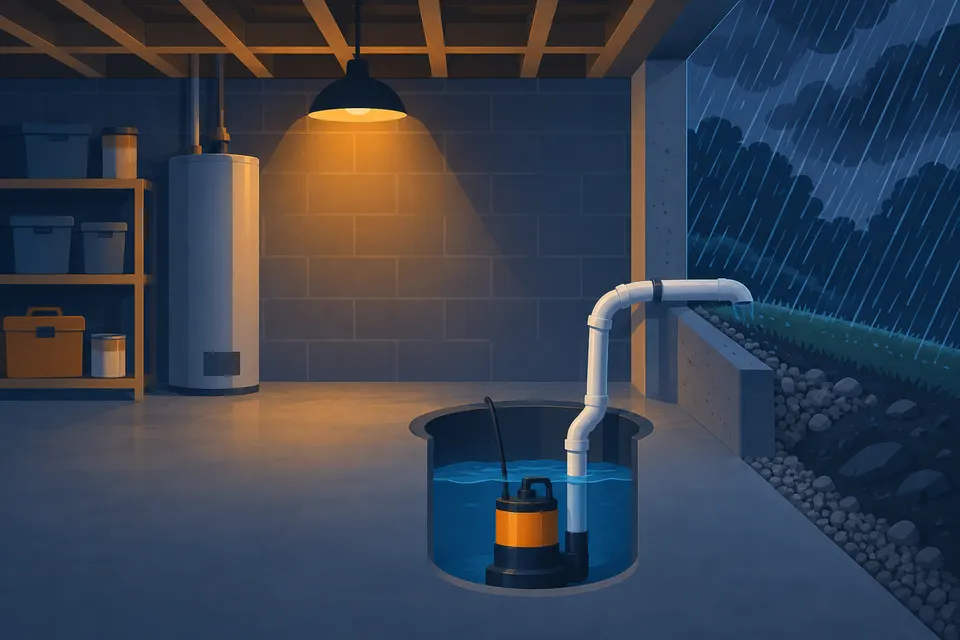
A dedicated backup pump is the set-and-forget choice, because it sits in the pit and switches on by itself. A power station can run your existing pump and other loads too, but only if its surge rating clears about 1,800 W and its capacity covers your pit's duty cycle. Use the calculator above to test your own numbers.
On this page
Key Takeaways
- A "battery backup sump pump" usually means a second 12V pump with its own battery in the pit. A home power station is a different route: it runs the pump you already have.
- A 1/3 hp pump rated 5.2 A at 115 V draws about 598 W while running and roughly three times that, about 1,794 W, for the instant it starts.
- Energy need depends on how often the pump runs. At assumed 10%, 20% and 40% duty cycles, 24 hours needs about 1,690, 3,380 and 6,750 Wh.
- Surge rating decides whether the pump starts. Capacity decides how long it keeps running.
- Anything that touches house wiring is a job for a licensed electrician. For a pump, plug it straight into the station.
Models compared by spec
- Capacity
- 1,024 Wh
- Continuous output
- 1,800 W
- Battery type
- LiFePO4
- Expandable
- To 5,000 Wh
- 240V
- No
- Weight
- 27.6 lb
- Capacity
- 2,048 Wh
- Continuous output
- 2,400 W
- Battery type
- LiFePO4
- Expandable
- To 4,096 Wh
- 240V
- No
- Weight
- 41.7 lb
- Capacity
- 2,048 Wh
- Continuous output
- 2,400 W
- Battery type
- LiFePO4
- Expandable
- Yes
- 240V
- No
- Weight
- 45 lb
- Capacity
- 2,073.6 Wh
- Continuous output
- 2,600 W
- Battery type
- LiFePO4
- Expandable
- No
- 240V
- No
- Weight
- 53.35 lb
- Capacity
- 2,764.8 Wh
- Continuous output
- 3,840 W
- Battery type
- LiFePO4
- Expandable
- To 19,354 Wh
- 240V
- Yes
- Weight
- 83.78 lb
- Capacity
- 3,072 Wh
- Continuous output
- 3,600 W
- Battery type
- LiFePO4
- Expandable
- To 12,288 Wh
- 240V
- Linked
- Weight
- 91.5 lb
- Capacity
- 3,072 Wh
- Continuous output
- 3,600 W
- Battery type
- LiFePO4
- Expandable
- No
- 240V
- No
- Weight
- 59.52 lb
- Capacity
- 3,072 Wh
- Continuous output
- 3,600 W
- Battery type
- LiFePO4
- Expandable
- To 15,360 Wh
- 240V
- No
- Weight
- 83.3 lb
- Capacity
- 3,072 Wh
- Continuous output
- 3,600 W
- Battery type
- LiFePO4
- Expandable
- Yes
- 240V
- Linked
- Weight
- 79 lb
- Capacity
- 3,072 Wh
- Continuous output
- 3,600 W
- Battery type
- LiFePO4
- Expandable
- Yes
- 240V
- No
- Weight
- 63.3 lb
- Capacity
- 3,600 Wh
- Continuous output
- 3,600 W
- Battery type
- LiFePO4
- Expandable
- To 10,800 Wh
- 240V
- Linked
- Weight
- 99 lb
- Capacity
- 3,840 Wh
- Continuous output
- 6,000 W
- Battery type
- LiFePO4
- Expandable
- To 26,880 Wh
- 240V
- Yes
- Weight
- 136.7 lb
- Capacity
- 3,993.6 Wh
- Continuous output
- 3,600 W
- Battery type
- LiFePO4
- Expandable
- To 20,000 Wh
- 240V
- Linked
- Weight
- 115.74 lb
- Capacity
- 4,096 Wh
- Continuous output
- 4,000 W
- Battery type
- LiFePO4
- Expandable
- Yes
- 240V
- Yes
- Weight
- 113.54 lb
- Capacity
- 5,040 Wh
- Continuous output
- 7,200 W
- Battery type
- LiFePO4
- Expandable
- Yes
- 240V
- Yes
- Weight
- 134.5 lb
- Capacity
- 5,120 Wh
- Continuous output
- 7,200 W
- Battery type
- LiFePO4
- Expandable
- To 35,800 Wh
- 240V
- Yes
- Weight
- 123.9 lb
- Capacity
- 6,144 Wh
- Continuous output
- 7,200 W
- Battery type
- LiFePO4
- Expandable
- To 30,720 Wh
- 240V
- Yes
- Weight
- —
Specs from manufacturer pages, checked Nov 2026. Each model page links the source of every value. “Linked” 240V means 240V only by pairing two units or with the brand’s hub, not from one unit alone.
No model in our list matches every filter. Clear a filter, or see how expansion batteries and two linked units change the picture on each model page.
What is a battery backup sump pump?
The first option is a purpose-built system. Pentair describes the parts as a 12V backup pump, a battery that is "completely separate from your home's standard power supply," and a smart charger [1]. When grid power is lost, the battery runs the backup pump. Pentair states that its Premium models can run up to 6 days, about 11,500 gallons per charge. That is a manufacturer claim, and the result in a real pit depends on inflow.
Bob Vila's guide separates two layouts. A standalone backup "must be installed alongside a primary electric sump pump," while a combination unit has "both a primary pump and a backup pump nested together" [2]. It also reports that a 12-volt battery can range from 40 to 80 amp hours, that runtime depends on how much water enters the pit, and that batteries lose charge-holding ability after about four or five years.
When does each option make sense?
| Question | Dedicated backup pump | Power station running your AC pump |
|---|---|---|
| What it powers | The backup pump only | The pump plus anything else you plug in |
| Pump in the pit | A second 12V pump is added | Your existing pump, unchanged |
| Switches on by itself | Yes, with its own float switch | Only while the station is on and your pump's float works |
| Main limit | Battery size and age | Surge rating, capacity and your duty cycle |
| Install | Plumbing in the pit (some communities require a licensed plumber, per Bob Vila) | Plug-in, no wiring changes |
A dedicated system fits best when the pit is the only thing you need to protect, or when the pump must keep working with nobody home. It also covers the case where the main pump fails while power is still on. A power station fits when you already want backup power for a refrigerator or furnace fan and would like the pump covered by the same unit. Many homes use both. This page covers the second option in detail, because that is where the math is less obvious.
How many watts does your sump pump need?
Watts are volts multiplied by amps, and the nameplate gives both. Virginia Cooperative Extension describes finding "the current draw (in amperes)" and multiplying it by the voltage [3]. Liberty Pumps lists its 250 Series 1/3 hp pump as 115 V and 5.2 A [4].
- Running: 5.2 A x 115 V = 598 W
- Start-up: the same extension publication notes a motor meter shows "about three times more current" while starting, so roughly 3 x 598 = 1,794 W for a moment
Your pump will differ, so read its label and replace these numbers. Our calculator preset uses this Liberty example, with the 3x factor as a rule of thumb rather than a measurement of any specific pump.
How long will a battery run a sump pump?
A pump does not run all day. How often it runs depends on how fast water enters the pit, so the duty cycle is an assumption you set, not a fact we can look up. Bob Vila's example shows how much it swings: a 40 amp hour battery lasts about 32 hours when the pump cycles every four minutes and about 8 hours when it cycles every minute [2].
For a station, the formula is running watts x hours x duty cycle, divided by 0.85. The 0.85 is our planning assumption for inverter losses, not a government figure. Here are the results for the 598 W pump.
| Duty cycle (assumed) | Average draw | Wh for 24 hours | Wh for 48 hours |
|---|---|---|---|
| 10% (light inflow) | about 60 W | about 1,690 | about 3,380 |
| 20% (our default) | about 120 W | about 3,380 | about 6,750 |
| 40% (heavy inflow) | about 240 W | about 6,750 | about 13,510 |
If you want hours instead of Wh, the runtime calculator does the same arithmetic, and the sizing tool adds your other appliances. Use the calculator above for this page's pre-filled pump. If you plan to recharge from panels during a long outage, see solar recharge time.
Surge rating or capacity: which matters more for starting?
Capacity tells you how long the pump runs, while surge rating tells you whether it starts. A large battery with a weak inverter can still trip on the 1,794 W start-up, while a smaller unit with enough surge starts it every time. Check the manufacturer's surge and continuous figures, and leave margin above 1,794 W because a nameplate-based 3x is an estimate.
These models list both a surge rating above that figure and a capacity in our comparison data. Hours use the same 598 W pump and 85% assumption. This is a by-spec fit, not a ranking.
| Model | Capacity (Wh) | Continuous / surge (W) | Hours at 10% | Hours at 20% | Hours at 40% |
|---|---|---|---|---|---|
| EcoFlow DELTA 3 Plus | 1,024 | 1,800 / 3,600 | 14.6 | 7.3 | 3.6 |
| Anker SOLIX C2000 Gen 2 | 2,048 | 2,400 / 4,000 | 29.1 | 14.6 | 7.3 |
| Anker SOLIX F3000 | 3,072 | 3,600 / 7,200 | 43.7 | 21.8 | 10.9 |
| OUPES Mega 3 | 3,072 | 3,600 / 7,000 | 43.7 | 21.8 | 10.9 |
| Jackery HomePower 3000 | 3,072 | 3,600 / 7,200 | 43.7 | 21.8 | 10.9 |
| EcoFlow DELTA Pro | 3,600 | 3,600 / 7,200 | 51.2 | 25.6 | 12.8 |
| Goal Zero Yeti PRO 4000 | 3,993.6 | 3,600 / 7,200 | 56.8 | 28.4 | 14.2 |
| EcoFlow DELTA Pro 3 | 4,096 | 4,000 / 8,000 | 58.2 | 29.1 | 14.6 |
Several other models in our data list a continuous output well above 1,794 W but no surge figure, for example the BLUETTI Apex 300 and BLUETTI Elite 200 V2. Ask the maker for a surge number before relying on one for a pump. Several units are expandable with extra batteries, which raises capacity but not necessarily surge. You can also browse by maker: EcoFlow, Anker SOLIX, Goal Zero, OUPES, Jackery, BLUETTI and Pecron.
Inverter idle draw is not modeled here, and it counts against a long outage. Check each spec sheet.
How should you connect the pump?
Plug the pump's cord directly into a station outlet, and do not wire a station into your house circuits yourself. OSHA's generator fact sheet warns that attaching a generator to a building electrical system "without a properly installed transfer switch can energize wiring systems for great distances," with electrocution risk for utility workers [5]. The same logic applies to any backup source. If you want a station to feed a panel, a transfer switch or interlock must be installed by a licensed electrician. Keep the station on a dry, raised spot, away from the pit.
For your full backup plan, see home backup power stations compared.
Frequently Asked Questions
Can a battery backup sump pump work without a primary pump?
A standalone backup is meant to sit alongside a primary pump, so you would need one in the pit [2]. Combination units include both pumps in one assembly.
How long will a battery run a sump pump?
It depends on inflow. Bob Vila's example drops from about 32 hours to about 8 hours as the pump cycles more often. For a station, use the 10%, 20% and 40% table above and replace the duty cycle with your own estimate.
Is a power station enough for a sump pump?
Possibly, if its surge rating clears roughly 1,794 W and its capacity covers your duty cycle for the outage length. Confirm both on the manufacturer's spec sheet and your pump's nameplate.
Can I use an extension cord?
Follow the pump maker's and station maker's manuals. We do not give wiring instructions here, and anything beyond a direct plug-in belongs with a licensed electrician.
Our Take
We see these as two tools for different jobs. If protecting the basement is the only goal, a dedicated 12V system is simpler, because it needs no wiring and has its own float switch. If you already want a station for a refrigerator or furnace fan, adding the sump pump is reasonable once the numbers fit: surge above about 1,800 W with margin, and Wh well above your duty cycle estimate. Plan for heavier inflow than you hope for, since storms that cause outages often fill pits fast. Read your own pump's nameplate before buying anything.
Sources
- Pentair Sump Pump Battery Backup. Pentair, 2026.
- Best Battery Backup Sump Pump. Bob Vila, 2026.
- Estimating Appliance and Home Electronic Energy Use (2901-9014). Virginia Cooperative Extension, 2026.
- 250 Series Submersible Sump/Effluent Pump. Liberty Pumps, 2026.
- Using Portable Generators Safely. OSHA, 2026.
General information, not electrical, medical or safety advice. Wattages are typical figures; check the label on your own appliance. Connecting backup power to home wiring needs a transfer switch or interlock installed by a licensed electrician. Spotted an error? Tell us.
More Home Backup Guides

Power Station vs Generator for Home Backup: How to Choose
Portable power station vs generator for home backup: energy versus fuel, surge, indoor use, carbon monoxide rules, upkeep and wiring, plus a decision flow.

Backup Power for Medical Devices: How to Check the Power Draw
How to find the watts on your home medical equipment label, turn them into watt-hours for an outage, and what to ask your provider and utility first.

Portable Power Station for a Gas Furnace: What Size Do You Need?
A gas furnace still needs electricity for its blower and controls. See how many watt-hours 12, 24 and 48 hours take, and what the hookup requires.
Battery Backup for a Refrigerator: How Big a Power Station You Need
How much battery backup a refrigerator needs: running vs start-up watts, daily Wh, 12, 24 and 48 hour sizing, food-safety timing, and models that fit.