LiFePO4 vs NMC for a Home Backup Power Station
Quick Answer
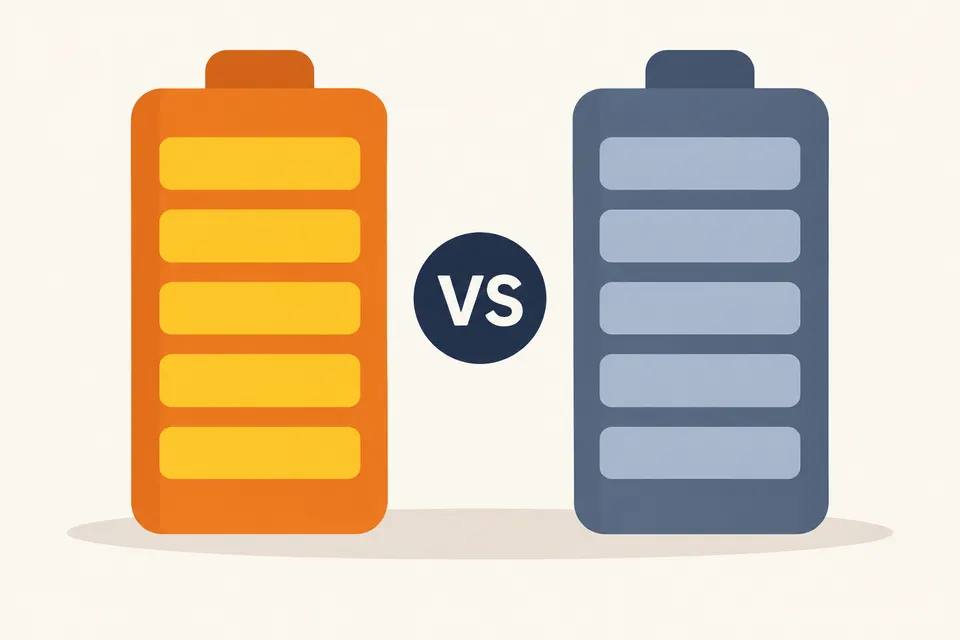
For a home backup power station, LiFePO4 is the chemistry the makers in our database use, and it is the one with long rated cycle life. NMC cells pack more energy into less weight in lab comparisons. Do not compare cycle numbers until you know whether each maker counts to 80% or to 70% of original capacity, and check the manual for the cold charging limit.
On this page
- What is the difference between LiFePO4 and NMC?
- Why are cycle ratings from different makers not comparable?
- How do weight and energy density compare?
- Is one chemistry safer in a thermal event?
- What do the manuals say about cold weather?
- How should you store a power station between outages?
- Frequently Asked Questions
- Our Take
- Sources
Key Takeaways
- LiFePO4 (also written LFP) and NMC are two lithium-ion cell chemistries. Every one of the 17 home backup models in our database lists LiFePO4, so for this category the practical question is how to read the specs, not which chemistry to pick.
- A cycle rating only means something with its end point. Makers state "to 80%" or "to 70%" of original capacity, and a battery reaches 70% later than 80%, so the two numbers cannot be compared directly.
- In peer-reviewed lab cycling of single cells, LiFePO4 lasted longer than NMC, but the result changed a lot with temperature, depth of discharge and discharge rate.
- Cold charging limits come from the maker's manual. Two LiFePO4 manuals we read both stop charging below 0 C (32 F).
- Storage advice is similar across makers: leave the unit partly charged, keep it out of heat, and top it up on a schedule.
What is the difference between LiFePO4 and NMC?
The name describes the cathode. In the Sandia National Laboratories cycling study, the three common commercial chemistries are written as LiFePO4 (LFP), LiNiCoAlO2 (NCA) and LiNiMnCoO2 (NMC) [1]. LFP and LiFePO4 are the same thing, and "lithium iron phosphate vs lithium ion" is a slightly misleading search phrase, because LiFePO4 is itself a lithium-ion chemistry.
We could not find any current home backup model in our database that lists NMC. All 17 entries in our data list LiFePO4, from the BLUETTI Apex 300 to the Jackery HomePower 3000. NMC shows up more in lighter portable units and in electric vehicles, so the comparison below uses research on the chemistries rather than product examples of NMC.
| Topic | LiFePO4 (LFP) | NMC |
|---|---|---|
| Cathode | Iron phosphate | Nickel, manganese, cobalt oxide |
| Cycle life in a Sandia 18650 cell study | 2,500 to 9,000 equivalent full cycles to reach the test conditions' end point | 200 to 2,500 equivalent full cycles |
| Energy per weight | Lower; Sandia describes "limited energy density" | Higher in the lab comparison below |
| Thermal runaway intensity (lab calorimetry) | "Significantly reduced" per Sandia | Higher than LFP in the same chart |
| Used in home backup models we list | All 17 | None listed |
The cycle numbers above are lab cell results, not product ratings. They are explained in the next section.
Why are cycle ratings from different makers not comparable?
A cycle rating is only half a sentence. The other half is the capacity at which the battery is considered worn out. Sandia notes that 80% of original capacity "is often the reference used by manufacturers in specification sheets to indicate end of life" [1]. Some makers use a different line.
Jackery is a clear case. Its FAQ for the Explorer 3000 v2 (the same unit as the HomePower 3000) lists "4000 cycles≥70%" [6]. Our data records the same 70% basis for the Explorer 5000 Plus. A battery loses its first 20% before it loses 30%, so 4,000 cycles to 70% means fewer cycles to 80%. A 4,000-cycle rating to 80% and a 4,000-cycle rating to 70% are not the same promise.
Conditions matter as much as the end point. In the Sandia study, "the equivalent full cycle count at 80% capacity varied up to thousands of cycles depending on the conditions" within the maker's own operating limits [1]. A rating is a maker's figure under its own test plan. Treat it as a way to rank similar products on the same basis, not as a lifetime in years.
Here are the cycle ratings in our database for the 16 models with a listed figure. Jackery is shown separately because it counts to 70%, and two Anker entries do not state an end point.
EcoFlow's DELTA Pro manual lists "3500 cycles to 80%+ capacity" [4], which is the clean kind of rating: a number and an end point. Where the end point is missing, as with the two Anker entries, you cannot place the rating against the others.
Chemistry is also not a guaranteed ranking. A 2022 peer-reviewed paper from Dalhousie University reported NMC532 cells with "a cycle-life that greatly exceeds that of the LFP cells at 40 C, 55 C and 70 C", using NMC cells built for a lower charge voltage [3]. That is a narrow test setup, not a rule. It does show that the cell design and charging limits matter alongside the chemistry name.
How do weight and energy density compare?
Sandia's thermal runaway slides describe LFP as providing "significantly reduced thermal runaway intensities, but have limited energy density" [2]. The Dalhousie paper also found the NMC532 cells had "an energy density that exceeds that of the LFP cells" [3]. So per pound of cell, NMC stores more energy. We do not quote a percentage because the sources we could fetch did not give a same-basis figure for finished power stations.
What you can compare today is the maker's listed capacity and weight. The last column below is our own division of the two listed numbers, so it describes the whole unit including the inverter and housing, not just the cells.
| Model | Chemistry | Rated cycles (maker) | Capacity | Weight | Wh per lb (calculated) |
|---|---|---|---|---|---|
| BLUETTI Apex 300 | LiFePO4 | 6,000 | 2,764.8 Wh | 83.78 lb | 33.0 |
| EcoFlow DELTA Pro 3 | LiFePO4 | 4,000 | 4,096 Wh | 113.54 lb | 36.1 |
| Goal Zero Yeti PRO 4000 | LiFePO4 | 4,000 | 3,993.6 Wh | 115.74 lb | 34.5 |
| Anker SOLIX F3800 Plus | LiFePO4 | 3,000 (end point not stated) | 3,840 Wh | 136.7 lb | 28.1 |
| Jackery Explorer 5000 Plus | LiFePO4 | 4,000 to 70% | 5,040 Wh | 134.5 lb | 37.5 |
| Jackery HomePower 3000 | LiFePO4 | 4,000 to 70% | 3,072 Wh | 59.52 lb | 51.6 |
| Anker SOLIX C2000 Gen 2 | LiFePO4 | 4,000 | 2,048 Wh | 41.7 lb | 49.1 |
| Pecron F5000LFP | LiFePO4 | 4,000 | 5,120 Wh | 123.9 lb | 41.3 |
| Pecron E3600LFP | LiFePO4 | 3,500 | 3,072 Wh | 79 lb | 38.9 |
| Pecron F3000LFP | LiFePO4 | 3,500 | 3,072 Wh | 63.3 lb | 48.5 |
| Pecron E2400LFP | LiFePO4 | 3,500 | 2,048 Wh | 45 lb | 45.5 |
| OUPES Mega 3 | LiFePO4 | 3,500 | 3,072 Wh | 83.3 lb | 36.9 |
Every row is LiFePO4, yet the calculated figure runs from 28.1 to 51.6 Wh per lb. Case, inverter size, wheels and expansion hardware change the weight as much as the cell chemistry does. If carrying weight matters, compare the listed weight of the exact model, and see brand pages for each maker's lineup.
Is one chemistry safer in a thermal event?
Be careful here. Sandia's calorimetry work says LFP cells have "significantly reduced thermal runaway intensities" compared with the other chemistries it charted [2]. The same slides add a warning: "High capacity LFP cells show thermal runaway rates not typically seen in smaller cells."
Taken together, that supports a modest statement: in lab tests, LFP cells release less heat energy when they go into thermal runaway. It does not support a claim that a LiFePO4 power station cannot fail, and we are not making one. Intensity is not the same as likelihood, and a finished product depends on its battery management system, enclosure and certification. Keep any battery on a hard surface, away from flammable material, with working smoke detection, and follow the manual.
What do the manuals say about cold weather?
A winter outage is when this matters. Two LiFePO4 manuals we read set the same floor for charging, even though they allow discharging in colder air.
EcoFlow's DELTA Pro manual lists a charge temperature of 0 to 45 C (32 to 113 F) and a discharge range of -10 to 45 C (14 to 113 F), and adds that whether the product can be charged or discharged "depends on the actual temperature of the battery pack" [4]. BLUETTI's Apex 300 manual lists charging at 0 to 40 C (32 to 104 F) and discharging at -20 to 40 C (-4 to 104 F), and its error table says a "Charging temperature too low" fault means placing the unit in air between 0 and 40 C [5].
The practical point: a garage unit that sat in a freeze may power your loads but refuse to take a charge until it warms. These two manuals are what we verified. We did not find a source that compares NMC power stations on this limit, so we do not claim LiFePO4 is better or worse in the cold. If you plan to run solar charging in winter, read the charge limit for your exact model and use the solar and runtime tools with that in mind.
The Sandia study offers one narrow, related finding: in the 15 to 35 C range, capacity fade rate "increased with increasing temperature for LFP cells but decreased for NMC cells," and the authors wrote that LFP cells "are more suited for lower temperature applications" [1]. That is about aging in a normal range, not about charging below freezing.
How should you store a power station between outages?
A backup unit spends most of its life waiting. Both manuals we read give a partial charge and a schedule.
- EcoFlow: for storage, its DELTA Pro manual says to charge and discharge the unit once every 3 months ("fully charge it, then discharge to 60% for storage") and not to leave it uncharged or unused for more than 6 months [4].
- BLUETTI: charge to 40% to 60% before storing, power off and disconnect cables, and "fully cycle every 3 months" [5].
- Both give storage temperature limits; EcoFlow says ideal storage is 20 to 30 C (68 to 86 F) and not above 45 C (113 F) for long periods.
We do not give a self-discharge percentage, because we could not find a maker or lab source for a power station. The takeaway is simple: a "set it and forget it" unit still needs a calendar reminder. If you want to size the battery before worrying about storage, start with the home backup sizing tool.
Frequently Asked Questions
Is LiFePO4 the same as LFP?
Yes. LFP is the shorthand for lithium iron phosphate, written LiFePO4. Sandia's study uses both names for the same cell type [1].
Do LiFePO4 power stations really last 6,000 cycles?
That is the maker's rating for the BLUETTI Apex 300 and Elite 200 V2 in our data, not an independent result. Sandia found the cycles to 80% capacity varied by thousands depending on temperature, depth of discharge and discharge rate, so treat any rating as a comparison tool on a stated end point.
Why does Jackery list 4,000 cycles when others list 4,000 too?
Jackery counts to 70% of original capacity, while most others in our data count to 80% or do not say. Four thousand cycles to 70% means fewer than 4,000 cycles to 80%, so the numbers are not equal.
Can I charge a power station in freezing weather?
Check your manual. The EcoFlow DELTA Pro and BLUETTI Apex 300 manuals both set 0 C (32 F) as the lowest charging temperature, even though they allow discharging in colder air.
Is NMC bad for a backup battery?
We do not say that. NMC cells store more energy per weight in lab comparisons, and none of the home backup models in our database use it. The choice is made by the maker, so compare the listed specs and manual limits of the exact model.
Our Take
We think the chemistry label matters less than three lines in the manual: the cycle end point (80% or 70%), the lowest charging temperature, and the storage routine. Every home backup model we track already uses LiFePO4, so the more useful work is reading those lines for the specific unit you are considering. We would avoid ranking models on a raw cycle number when the end points differ, and we would treat any "can't catch fire" claim with suspicion, since the research we found only supports lower thermal runaway intensity in cells. Match the battery to your loads first, then use these details to break ties.
Sources
- Degradation of Commercial Lithium-ion Cells as a Function of Chemistry and Cycling Conditions. Sandia National Laboratories (Preger et al.), 2020.
- Evaluating thermal runaway risks in high energy density cells. Sandia National Laboratories (Lamb), 2019.
- Li[Ni0.5Mn0.3Co0.2]O2 as a Superior Alternative to LiFePO4 for Long-Lived Low Voltage Li-Ion Cells. Aiken et al. (Dalhousie University), 2022.
- DELTA Pro User Manual. EcoFlow, 2026.
- Apex 300 User Manual V3.1. BLUETTI, 2025.
- Explorer 3000 V2 Basic Information. Jackery, 2026.
General information, not electrical, medical or safety advice. Wattages are typical figures; check the label on your own appliance. Connecting backup power to home wiring needs a transfer switch or interlock installed by a licensed electrician. Spotted an error? Tell us.
More Home Backup Guides

Power Outage Checklist: How to Prepare Before, During and After
A practical power outage checklist for US homeowners: what to do before, during and after an outage, plus how to size backup power for your critical loads.
Winter Storm Power Outage Backup: How to Size a Home Battery Plan
Plan backup power for a winter storm outage: which loads matter, why space heaters drain batteries fast, 48-hour sizing math, cold limits and safe placement.
How to Connect a Power Station to Your House: The Safe Options Overview
How to connect a power station to your house: overview of cords, transfer switches, interlock kits and maker panels, and why a licensed electrician is needed.